Economic tools to promote transparency and comparability in the Paris Agreement
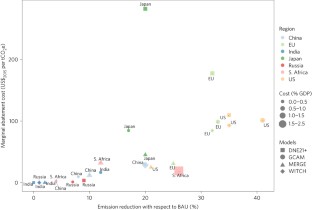
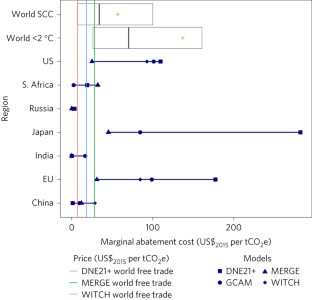
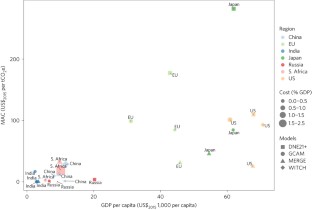
The Paris Agreement culminates a six-year transition towards an international climate policy architecture based on parties submitting national pledges every five years 1 . An important policy task will be to assess and compare these contributions 2,3 . We use four integrated assessment models to produce metrics of Paris Agreement pledges, and show differentiated effort across countries: wealthier countries pledge to undertake greater emission reductions with higher costs. The pledges fall in the lower end of the distributions of the social cost of carbon and the cost-minimizing path to limiting warming to 2 °C, suggesting insufficient global ambition in light of leaders’ climate goals. Countries’ marginal abatement costs vary by two orders of magnitude, illustrating that large efficiency gains are available through joint mitigation efforts and/or carbon price coordination. Marginal costs rise almost proportionally with income, but full policy costs reveal more complex regional patterns due to terms of trade effects.
This is a preview of subscription content, access via your institution
Access options
Subscribe to this journal
Receive 12 print issues and online access
206,07 € per year
only 17,17 € per issue
Buy this article
- Purchase on SpringerLink
- Instant access to full article PDF
Prices may be subject to local taxes which are calculated during checkout
Paris targets within reach by aligning, broadening and strengthening net-zero pledges
Article Open access 23 January 2024

Quantification of an efficiency–sovereignty trade-off in climate policy
Article 09 December 2020
Supporting the Paris Agreement through international cooperation: potential contributions, institutional robustness, and progress of Glasgow climate initiatives
Article Open access 29 April 2024
References
- Keohane, R.O. & Victor, D. G. Cooperation and discord in global climate policy. Nat. Clim. Change6, 570–575 (2016). ArticleGoogle Scholar
- Aldy, J. E. & Pizer, W. A. Alternative metrics for comparing domestic climate change mitigation efforts and the emerging international climate policy architecture. Rev. Environ. Econ. Policy10, 3–24 (2016). ArticleGoogle Scholar
- Aldy, J. E., Pizer, W. A. & Akimoto, K. Comparing emissions mitigation efforts across countries. Clim. Policy 1–15 (2016).
- Schelling, T. C. An essay on bargaining. Am. Econ. Rev.46, 281–306 (1956). Google Scholar
- Chayes, A. & Chayes, A. H. Compliance without enforcement: state behavior under regulatory treaties. Negotiation J.7, 311–330 (1991). ArticleGoogle Scholar
- Barrett, S. Environment and statecraft: the strategy of environmental treaty-making. Manag. Environ. Qual.14, 622–623 (2003). ArticleGoogle Scholar
- Bodansky, D., Brunnée, J. & Hey, E. The Oxford Handbook of International Environmental Law (Oxford Univ. Press, 2007). Google Scholar
- Victor, D. G. in Architectures for Agreement: Addressing Global Climate Change in the Post-Kyoto World (eds Stavins, R. N. & Aldy, J. E.) 133–172 (Cambridge Univ. Press, 2007). BookGoogle Scholar
- Pizer, W. A. in Architectures for Agreement: Addressing Global Climate Change in the Post-Kyoto World (eds Stavins, R. N. & Aldy, J. E.) 280–314 (Cambridge Univ. Press, 2007). BookGoogle Scholar
- Ostrom, E. A behavioral approach to the rational choice theory of collective action: presidential address, American Political Science Association, 1997. Am. Political Sci. Rev.92, 1–22 (1998). ArticleGoogle Scholar
- den Elzen, M. G. J., Hof, A. F. & Roelfsema, M. The emission gap between the Copenhagen pledges and the 2 °C climate goal: options for closing and risks that could widen the gap. Glob. Environ. Change21, 733–743 (2011). ArticleGoogle Scholar
- The Emission Gap Report 2010: Are the Copenhagen Pledges Sufficient to Limit Global Warming to 2 °C or 1.5 °C? (UN Environment Programme, 2010).
- Thompson, A. Management under anarchy: the international politics of climate change. Climatic Change78, 7–29 (2006). ArticleGoogle Scholar
- Aldy, J. E. The crucial role of policy surveillance in international climate policy. Climatic Change126, 279–292 (2014). ArticleGoogle Scholar
- Aldy, J. E. in Handbook on Energy and Climate Change (ed. Fouquet, R.) 352–374 (Elgar, 2012). Google Scholar
- Manne, A., Mendelsohn, R. & Richels, R. MERGE. Energy Policy23, 17–34 (1995). ArticleGoogle Scholar
- Aldy, J. E. Evaluating Mitigation Effort: Tools and Institutions for Assessing Nationally Determined Contributions (Harvard Project on Climate Agreements, 2015). Google Scholar
- Houser, T. Copenhagen, the Accord, and the way Forward (Peterson Institute for International Economics, 2010). Google Scholar
- Dellink, R., Briner, G. & Clapp, C. Costs, Revenues, and Effectiveness of the Copenhagen Accord Emission Pledges for 2020 (OECD, 2010). Google Scholar
- McKibbin, W. J., Morris, A. C. & Wilcoxen, P. J. Comparing climate commitments: a model-based analysis of the Copenhagen Accord. Climate Change Economics2, 79–103 (2011). ArticleGoogle Scholar
- Clarke, L. et al. International climate policy architectures: overview of the EMF 22 International Scenarios. Energy Econ.31, S64–S81 (2009). ArticleGoogle Scholar
- Kriegler, E., Tavoni, M., Riahi, K. & vanVuuren, D. P. Introducing the limits special issue. Clim. Change Econ.4, 1302002 (2013). ArticleGoogle Scholar
- Kriegler, E. et al. Making or breaking climate targets: the AMPERE study on staged accession scenarios for climate policy. Technol. Forecast. Soc. Change90, 24–44 (2015). ArticleGoogle Scholar
- Tavoni, M. et al. Post-2020 climate agreements in the major economies assessed in the light of global models. Nat. Clim. Change5, 119–126 (2015). ArticleGoogle Scholar
- Fawcett, A. A. et al. Can Paris pledges avert severe climate change? Science350, 1168–1169 (2015). ArticleCASGoogle Scholar
- Cai, Y., Judd, K. L. & Lontzek, T. S. The social cost of carbon with economic and climate risks. Preprint at http://arxiv.org/abs/1504.06909 (2015).
- Stern, D. I., Pezzey, J. C. V. & Lambie, N. R. Where in the world is it cheapest to cut carbon emissions? Aust. J. Agric. Resour. Econ.56, 315–331 (2012). ArticleGoogle Scholar
- Bodansky, D. M., Hoedl, S. A., Metcalf, G. E. & Stavins, R. N. Facilitating linkage of climate policies through the Paris outcome. Clim. Policy 1–17 (2015).
- Cooper, R. in Post-Kyoto International Climate Policy: Implementing Architectures for Agreement (eds Stavins, R. N. & Aldy, J. E.) 151–78 (Cambridge Univ. Press, 2010). Google Scholar
- Akimoto, K. et al. Comparison of marginal abatement cost curves for 2020 and 2030: longer perspectives for effective global GHG emission reductions. Sustain. Sci.7, 157–168 (2012). ArticleGoogle Scholar
- Akimoto, K. et al. Estimates of GHG emission reduction potential by country, sector, and cost. Energy Policy38, 3384–3393 (2010). ArticleCASGoogle Scholar
- Joint Global Change Research Institute Global Change Assessment Model v. 4.2 (Pacific Northwest National Laboratory, 2015); http://www.globalchange.umd.edu/archived-models/gcam/download
- Blanford, G., Merrick, J., Richels, R. & Rose, S. Trade-offs between mitigation costs and temperature change. Climatic Change123, 527–541 (2014). ArticleGoogle Scholar
- Bosetti, V., Carraro, C., Galeotti, M., Massetti, E. & Tavoni, M. WITCH: A world induced technical change hybrid model. Energy J.27, 13–38 (2006). Google Scholar
- Technical Support Document: Technical Update of the Social Cost of Carbon for Regulatory Analysis Under Executive Order 12866 (US Environmental Protection Agency, 2015).
- Council of Economic Advisers Economic Report of the President (US Government Publishing Office, 2016).
Acknowledgements
The Research Institute of Innovative Technology for the Earth provided financial support for this project. L.E.C., J.E., G.C.I. and H.C.M. were supported by the Global Technology Strategy Project. The views expressed here reflect those of the individual authors and not necessarily those of EPRI or its members.
Author information
Authors and Affiliations
- Harvard University, Cambridge, Massachusetts 02138, USA Joseph Aldy
- Resources for the Future, Washington DC 20036, USA Joseph Aldy & William Pizer
- National Bureau of Economic Research, Cambridge, Massachusetts 02138, USA Joseph Aldy & William Pizer
- Center for Strategic and International Studies, Washington DC 20036, USA Joseph Aldy
- Duke University, Durham, North Carolina 27708, USA William Pizer
- Fondazione Eni Enrico Mattei (FEEM), Milan 20123, Italy Massimo Tavoni, Lara Aleluia Reis & Carlo Carraro
- Centro Euromediterraneo sui Cambiamenti Climatici (CMCC), Milan 20123, Italy Massimo Tavoni, Lara Aleluia Reis & Carlo Carraro
- Department of Management and Economics, Politecnico di Milano, Milan 20133, Italy Massimo Tavoni
- Research Institute of Innovative Technology for the Earth, Kyoto 619-0292, Japan Keigo Akimoto & Fuminori Sano
- Energy and Environmental Analysis Research Group, Electric Power Research Institute (EPRI), Palo Alto, California 94304, USA Geoffrey Blanford, Richard Richels & Steven Rose
- University of Venice, Venice 30123, Italy Carlo Carraro
- Joint Global Change Research Institute, Pacific Northwest National Laboratory, College Park, Maryland 20740, USA Leon E. Clarke, James Edmonds, Gokul C. Iyer & Haewon C. McJeon
- Joseph Aldy
